
There is something particular about the days that follow a wedding. The dress hangs still. The venue empties. Guests return to their lives. And the flowers, which hours ago were held in nervous hands, pinned to lapels, and scattered across tables, begin their quiet decline. This is where Vancouver Island Wedding Flower Preservation can help you hold on to those memories a little longer.
Most couples photograph their bouquets. Some dry them. A smaller number find their way to Alicia.
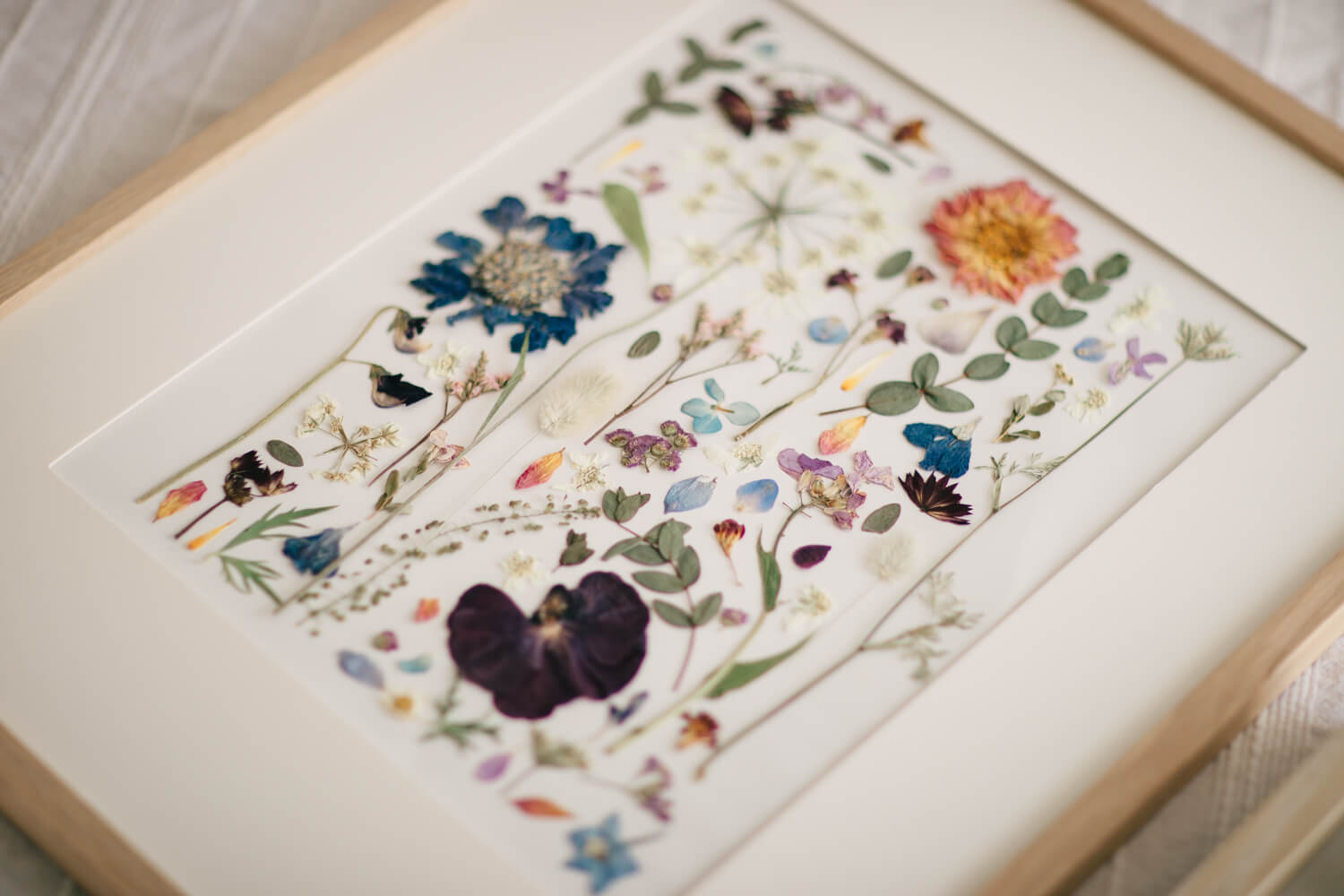
Alicia Yamasaki of Preserved Petals is a preservation artist working out of central Vancouver Island. Her practice sits at the intersection of nature, craft, and ceremony, and it is one of the few dedicated to Vancouver Island wedding flower preservation as a true art form. She presses wedding flowers, bouquets, loose blooms and transforms them into framed pieces of that couples can hang in their homes and look at every day. Not a photograph of the flowers. The flowers themselves, pressed flat and arranged by hand, sealed and sent into a life beyond the wedding.
It is a quiet art with very old roots. The oldest preserved flowers on record were found in an Egyptian tomb and are over two thousand years old, faded, but still intact, now held at the British Museum. The Egyptians wove dried flowers into garlands to accompany the dead into the afterlife, and pressed laurels were found in the sarcophagus of Tutankhamun’s mother.
In 16th century Japan, the practice became something more deliberate, an art form called Oshibana, in which samurai used pressed botanicals as a meditative discipline, arranging them into pictures as a way of cultivating patience and a connection to the natural world. As trade between Japan and the West grew in the 1800s, Oshibana travelled with it. By the Victorian era, pressing flowers had become a beloved pastime across England and North America, women collecting specimens from their gardens and travels, arranging them into albums alongside notes and poems, passing the books down through generations as a kind of living record of the places and seasons they had moved through.
There is something almost accidental about how the tradition continues to move through families, slipped between the pages of a book on a farm, forgotten, and discovered years later by a child. Alicia’s grandmother pressed flowers. Her mother did too. The practice never disappeared. It simply waited for the right hands to carry it forward.


How It Began
Alicia has been drawn to art and nature her whole life. Crafts, flowers, the particular satisfaction of making something with your hands. When she became a mother, something shifted.
“I’ve always been into crafts, like my whole life. I loved art and nature and especially flowers. And then once I became a mom, I actually craved more of a slower life. I had pressed flowers before, and I just thought why not make art with it, and started exploring that way, and then it just took off a lot faster than I thought it would.”
What started as a personal instinct grew into a full practice, one that now moves through wedding seasons with a steady rhythm of bouquets arriving at her door, paper being changed daily, and designs slowly coming together across weeks.
The Process: Vancouver Island Wedding Flower Preservation Start to Finish
Vancouver Island wedding flower preservation begins with a conversation. When a couple reaches out, Alicia talks through their vision, the style of the arrangement, whether the work is a good fit. From there, timing becomes everything.
She prefers to receive the flowers within five days of the wedding, ideally the day after. The fresher the blooms, the better the press. When the bouquet arrives, she documents everything before touching it.
“I take photos and video of the flowers, and then with a wooden press. And then I’m changing the paper out daily for the first couple weeks to make sure that the flowers are pressing the way that they should. There’s no mold or anything.”
For the first couple of weeks, this is the careful, unglamorous centre of the work. During peak wedding season she is managing multiple presses at once, dozens of couples’ flowers drying in careful layers. Once the flowers come out of the press, the design conversation begins.
“Typically during peak wedding season it’s a longer process just because I’m taking so many brides on a week. Then once I’m ready for designing, we’ll talk about designs. I’ll do a mockup, we’ll email back and forth, make sure that you’re happy with everything, and then seal it and send it off your way or pick it up.”
The Flowers She Loves
Ask Alicia which flowers she loves working with and she answers quickly: locally grown ones. This is not an aesthetic preference alone. It is something closer to a conviction.
“I love working with locally grown flowers. I try really hard to work with mostly local florists or flower farms, they’re my favorite, I love ranunculus, snapdragons, just anything that reminds me of the island, dahlias. They have lots of petals, but they always look beautiful. Cosmos. I just like flowers that are bright in color and that retain the color – that’s my preference. But I can make anything work, really.”
The flower farming community on Vancouver Island is tightly networked, she explains, with growers supporting each other and florists sourcing locally as a matter of course. It is the kind of ecosystem that produces bouquets with a sense of place.
For the farms and florists she returns to most often, she names Wild Bee Florals in Comox and Roo Floral in Coombs as her top two.
“I just love the island-grown flowers, to be honest. On the island, we just have so many amazing flower farmers, almost all the florists we work with are growing their own flowers, and they have their own little network where everyone’s supporting each other.”
Design as Instinct
The layout of a pressed flower piece is its own form of composition. When Alicia looks at a bouquet, certain flowers catch her eye immediately. Those become the focal points.
“Usually when I look at a bouquet, there’s a couple of flowers that catch my eye and those become the focal point. I do have a lot of people say designer’s choice, like whatever you want. But I’ll usually work around the bigger focal points, and then slowly add in the smaller flowers. It’s nice when there’s a variety, for sure, which most local florists do have. I give the brides and grooms an option of what they want, and then we go from there.”
Beyond the Bouquet: What Else Goes Into a Preserved Petals Piece
Pressed flowers are the centre of Alicia’s work, but the pieces she makes sometimes carry more than petals.
“I’ve had one lady who had some of her lace from her grandma’s dress, which was very sweet. And then there’s been some funnier things that have made it into the pieces, but mostly that, or vows. Handwritten vows were really popular. Photos. But yeah, the lace from the dress was definitely the sweetest for sure.”
The Philosophy of Organic Preservation
There is one thing Alicia is clear about, and she wants people to know it before they commission a piece.
“What I use, the process is completely organic. I don’t do any color correction. They do fade with time, but it is the way that I like to do it. I don’t like to put dyes and sprays or anything on it. It’s just the completely old-fashioned way of doing things.”
The flowers will fade over time. That is simply true. What you receive is the flower as it was, altered only by time and the slow, deliberate pressure of the press. There is honesty in that. A pressed flower that fades is still telling the truth about itself.


What’s Coming
Alicia is beginning to think about workshops. A lot of people have been asking, she says, whether she will come into a flower shop or studio and lead a hands-on session. It feels like a natural direction for someone whose practice already has a teaching quality to it, patient, methodical, rooted in doing.
“Something in the works right now is offering workshops. I’ve had a lot of people asking me if I’ll come into a florist or a flower shop and do a hands-on workshop with people. And then I would love to make more customized pieces when I have the time.”
The practice is still growing, still finding its shape.
For the Curious: Starting at Home
For anyone who wants to try pressing flowers without a commission or a wedding to anchor it, Alicia’s advice is simple.
“You can make a press out of anything, really. You could just take a big book, that’s what I used to do as a kid, and then take things that are really flat, like a pansy or a daisy, and just put them in the book and leave it alone for a couple months and go from there.”
She carries a small press when she travels, a children’s one she found in Coombs, and slips flowers into it along the way, adding them later to photo books. Small souvenirs from places she has been. The practice does not require a studio or a wedding or a particular flower. It requires only the habit of noticing what grows nearby – something Alicia has had her whole life.
Preserved petals carry something photographs cannot. They are the actual thing, the ranunculus from the bouquet, the snapdragon your florist sourced from a farm twenty minutes away, the cosmos your grandmother grew in her garden. Pressed and held in place, they become a kind of quiet archive of a day.
Alicia presses those days into frames on central Vancouver Island, one bouquet at a time.
Vancouver Island wedding flower preservation, and the slower, more deliberate life it represents, is exactly what she set out to build.
To inquire about preserved petals pieces for your Vancouver Island wedding, reach out to Alicia directly.
Interview & Photos by Sydney Woodward


Comments +